

Navigating the Archipelago: A Deep Dive into the Galapagos Islands Map and Top Visitor Sites
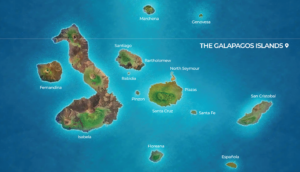
Understanding the geography of the most famous archipelago in the world is the first step toward a successful expedition. When travelers first look at a Galapagos Islands Map, they often see a scattered collection of volcanic peaks, but for the trained eye, this map is a blueprint of evolution. Each island, from the geologically young Fernandina in the west to the ancient, eroded cliffs of Española in the southeast, offers a completely different ecosystem. At GalapagosIsland.net, we believe that mastering the layout of these visitor sites is essential for choosing an itinerary that aligns with your wildlife bucket list, as the distance between islands dictates which species you will encounter.
The central hub of any Galapagos Islands Map is Santa Cruz Island, home to the town of Puerto Ayora and the vital Charles Darwin Research Station. From this central point, the archipelago radiates into distinct regions, each with its own “celebrity” species. To the north, the birdwatcher’s paradise of Genovesa Island awaits, tucked inside a collapsed submerged caldera. To the west, the massive Isabela Island, shaped like a seahorse, provides a rugged landscape of shield volcanoes and the best opportunities to see the Galapagos Penguin. Understanding these spatial relationships helps travelers realize why a single-day trip can only cover a fraction of the wonders hidden within the 13 major islands and dozens of smaller islets.
Navigating the visitor sites listed on a Galapagos Islands Map requires an understanding of the two primary navigation routes: the Western and Eastern loops. The Western route is defined by its volcanic activity and nutrient-rich waters, making it the premier choice for those wanting to see marine life and the stark beauty of young lava fields. Conversely, the Eastern and Southern routes focus on the oldest islands, where the white sand beaches of Gardner Bay and the dramatic “blowhole” of Española provide a more classic, tropical aesthetic. By studying the map before you book, you can ensure that your path crosses with the specific animals you’ve dreamed of seeing, whether it is the Waved Albatross or the Flightless Cormorant.
Beyond the major islands, the Galapagos Islands Map reveals hidden gems like Bartolome Island and its iconic Pinnacle Rock. These smaller visitor sites often provide the most breathtaking panoramic views, allowing travelers to see the volcanic “splatter cones” and the different colors of the ocean from above. Each site is strictly regulated by the Galapagos National Park to prevent overcrowding, which is why your itinerary is a carefully choreographed dance between islands. Knowing where these sites are located in relation to your home base—be it a luxury cruise or a waterfront inn—will help you manage your expectations regarding travel time and the physical intensity of the daily excursions.
Finally, a Galapagos Islands Map serves as a vital tool for understanding the seasonal changes in the archipelago. As the currents shift throughout the year, certain visitor sites become hotspots for specific behaviors, such as sea turtle nesting or sea lion pupping. By overlaying the wildlife calendar with the geographical layout of the islands, you can plan a journey that is perfectly timed. At GalapagosIsland.net, we use these maps to help our clients visualize their adventure, transforming a simple collection of coordinates into a personalized narrative of discovery that spans the most extraordinary volcanic landscape on the planet.
FAQs: Mastering the Geography of the Galapagos
Which islands are the best for seeing Giant Tortoises in the wild? While you can see them in breeding centers on several islands, the Galapagos Islands Map points toward the Highlands of Santa Cruz and San Cristobal as the premier spots for seeing these giants roaming freely in their natural, misty habitat.
How long does it take to travel between islands? Distances can be deceiving. A speedboat journey between inhabited hubs like Santa Cruz and Isabela takes about two hours. However, reaching the remote northern islands like Genovesa requires an overnight navigation on a cruise, which is why the map is so critical for planning your logistics.
Can I visit every site on the Galapagos Islands Map in one trip? It is nearly impossible to visit every site in a single week. Most 8-day cruises cover either the Western or Eastern portion of the map. To see the entire archipelago, we recommend a 15-day back-to-back itinerary or multiple land-based stays over two weeks.
Are all visitor sites accessible to everyone? Some sites involve “dry landings” onto piers, while others require “wet landings” where you wade through knee-deep water onto a beach. The topography also varies from flat sandy paths to steep, rocky volcanic trails. Consulting a detailed map with site descriptions will help you choose the adventure level that best fits your physical comfort.
Full Articles About Each Island in Galapagos